RBI MPC October 2026: Repo Rate Decision Today — What Borrowers, Savers and Investors Should Watch

The RBI Monetary Policy Committee is set to announce its October 2026 policy decision today. Here’s what the repo rate decision could mean for EMIs, loans, fixed deposits, savings and the Indian economy.
If you have a home loan, personal loan, business loan, FD or even a simple monthly budget, there is one number worth watching today: the RBI repo rate.
The Reserve Bank of India’s Monetary Policy Committee (MPC) has been meeting from October 5 to October 7, 2026. The policy decision is scheduled for October 7 at 10 AM IST, followed by the Governor’s press conference at noon.
The current repo rate is 5.25%.
Now the big question is: Will the RBI raise it, keep it unchanged or surprise the market with another move?
Most recent expectations have leaned towards a 25-basis-point hike to 5.50%, although that remains a forecast until the RBI actually announces its decision. Reuters reported that markets were already pricing in a 25-basis-point increase, while a larger 50-basis-point move was considered a smaller possibility.
So before the headlines start flying, let’s make the whole thing simple.
First: What exactly is the RBI deciding?
The MPC decides the policy repo rate and the broader monetary-policy stance.
In simple words, the repo rate influences the cost of money in the banking system.

When the repo rate rises, borrowing can become more expensive over time.
When it falls, borrowing conditions can become easier.
But there is an important point people often miss:
A repo-rate change does not automatically mean your EMI changes by exactly the same amount.
Your bank, loan benchmark, interest-rate type and reset terms all matter.
That’s why today’s announcement matters — but what happens to your personal finances depends on your individual situation.
RBI MPC October 2026: Key details
| What | Details |
|---|---|
| MPC meeting | October 5–7, 2026 |
| Decision date | October 7, 2026 |
| Expected announcement | 10 AM IST |
| Press conference | 12 PM IST |
| Current repo rate | 5.25% |
| Widely expected move | 25-bps hike |
| Possible rate after hike | 5.50% |
The RBI had kept the repo rate unchanged at 5.25% at its August policy meeting. The central bank had previously cut rates by a cumulative 125 basis points during 2025.
Why is this October RBI meeting getting so much attention?
Because several things are happening at once.
Inflation has moved above the RBI’s 4% medium-term target, while crude oil and global interest-rate conditions have added pressure.
At the same time, India’s economic growth remains relatively resilient.
That leaves the RBI with a familiar but difficult balancing act:
Control inflation without unnecessarily hurting economic growth.
Recent reporting said India’s August retail inflation was 4.82%, above the 4% target for a third consecutive month.
The rupee is another part of the picture.
The Indian currency closed around ₹96.42 per US dollar on October 6 as markets waited for the RBI’s decision.
So today’s decision isn’t just about one number.
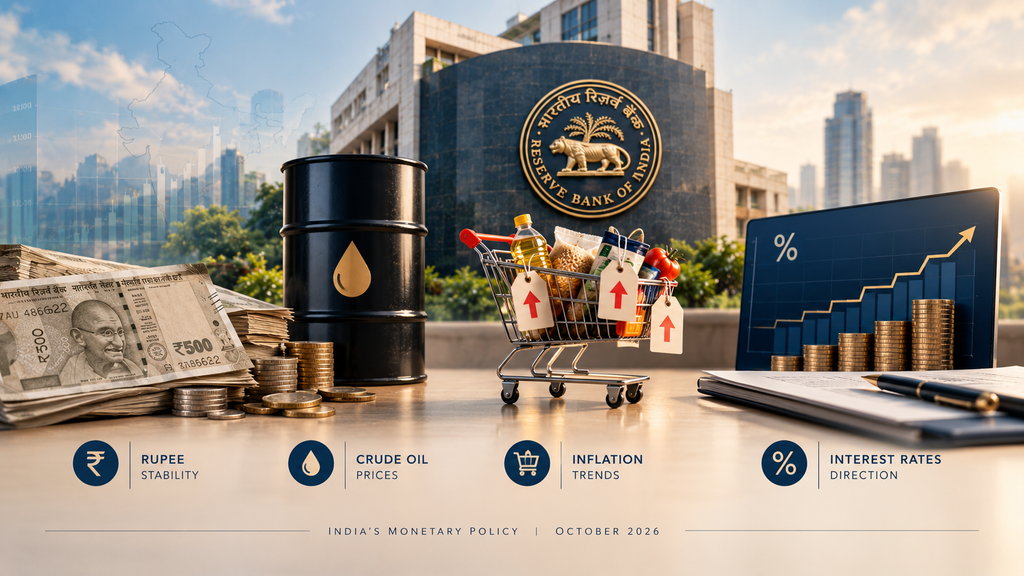
The RBI will also be watched for what it says about:
- Inflation
- Economic growth
- Crude oil prices
- The rupee
- Liquidity
- Global interest rates
- Future monetary policy
If you want to understand how the repo-rate decision could affect your EMI, loans and savings in more detail, read our earlier guide on the RBI MPC October 2026 decision- earlier guide on the RBI MPC October 2026 decision
What if RBI hikes the repo rate?
Let’s say the RBI increases the repo rate by 25 basis points, taking it from 5.25% to 5.50%.
That could put upward pressure on borrowing costs.
But don’t expect every loan EMI in India to suddenly jump the moment the announcement is made.
The actual impact depends on how your lender passes the change through and what your loan is linked to.
For borrowers, the main areas to watch are:
- Home loans
- Personal loans
- Business loans
- Vehicle loans
- Other floating-rate borrowing
If you have a floating-rate loan, today’s decision is a good reason to check your latest interest rate and reset terms.
What happens to home-loan EMIs?
This is probably the question most borrowers care about.
If your home loan is floating-rate and linked to an external benchmark, a change in the benchmark can eventually affect your interest rate.
Your lender may adjust:
Your EMI
or
Your loan tenure
or, depending on the loan structure, a combination of both.

So don’t assume:
RBI hikes 0.25% = my EMI automatically rises 0.25%.
That’s not how it works.
Your loan agreement and lender’s reset mechanism matter.
If you’re worried about your EMI, check your latest loan statement and find:
- Current interest rate
- Benchmark
- Reset date
- Outstanding principal
- Remaining tenure
Those five numbers will tell you much more than a headline about the RBI.
What about people planning to take a loan?
If you’re planning a large loan, today’s announcement is worth watching.
But don’t rush into borrowing just because everyone is talking about a possible rate hike.
Compare the complete cost of the loan:
- Interest rate
- Processing fee
- Tenure
- EMI
- Prepayment charges
- Total interest payable
A slightly lower advertised interest rate isn’t necessarily the cheapest loan if other charges are high.
What happens to fixed deposits?
This is where things get interesting for savers.
Higher interest rates can eventually support better deposit rates, but there is no automatic rule saying:
RBI hikes 25 bps → every FD rate rises 25 bps.
Banks decide their deposit rates based on their funding requirements, liquidity, competition and market conditions.

So if you have money in an FD, don’t break it simply because you hear that the RBI may hike rates.
Check:
- Current FD interest rate
- Maturity date
- Premature withdrawal penalty
- Tax implications
- Rates currently offered by other banks
Sometimes breaking an existing FD just to chase a slightly higher rate can actually leave you worse off.
And what about savings accounts?
The impact here can be less direct.
Savings-account interest rates are determined by individual banks and account structures.
So don’t assume your savings-account return will immediately move with the repo rate.
Instead, look at what your bank is actually offering.
Why does the rupee matter to the RBI?
The RBI doesn’t set interest rates just to control EMIs.
The broader economic environment matters.
The rupee has been under pressure against the US dollar, while global yields and energy prices have also been important market factors. India’s rupee has recently been trading near ₹96 against the US dollar, adding another layer to the RBI’s policy challenge
A weaker rupee can make imported goods and inputs more expensive.
And when crude oil prices are elevated, the effect can become more significant because India imports a large amount of its energy requirements.
That’s one reason currency and energy prices are part of the bigger monetary-policy picture.
What should you watch at 10 AM today?
Don’t just look for the headline:
“Repo rate increased”
or
“Repo rate unchanged.”
Look at the entire policy announcement.
1. Repo rate
Did it move from 5.25%?
2. Policy stance
Is the RBI signalling more tightening, patience or a different direction?
3. Inflation outlook
What does the RBI expect inflation to do over the coming months?
4. Growth outlook
Does the RBI remain comfortable with India’s economic growth?
5. Liquidity
Liquidity has also been an important part of the RBI’s recent policy actions, especially as the central bank has worked to manage surplus liquidity in the financial system. We explained that liquidity story here
6. Governor’s comments
Sometimes the explanation behind the decision tells us more about future policy than the headline number itself.
Three possible outcomes
There are three simple scenarios to understand.
Scenario 1: RBI hikes by 25 bps
The repo rate would move from 5.25% to 5.50%.
This would broadly match the expectation currently priced into markets.
Borrowers could face some upward pressure on borrowing costs, while savers could potentially benefit from stronger deposit rates over time.
Scenario 2: RBI keeps the rate unchanged
The repo rate would remain at 5.25%.
That could give borrowers some immediate relief from another increase, but the RBI’s statement would become especially important because markets would look for clues about what comes next.
Scenario 3: RBI makes a larger move
A 50-basis-point increase would be more aggressive and could surprise markets.
Recent market reporting has treated such a move as a smaller possibility rather than the main expectation.
If that happens, the RBI’s reasoning and future guidance would become particularly important.
What should borrowers do today?
Honestly?
Don’t panic.
You don’t need to change your entire financial plan because of one policy announcement.
Instead:
Check your loan rate.
Check your benchmark.
Check your reset date.
Know your outstanding balance.
And if you’re trying to get your finances under control this month, our October Money Reset can help you organise your spending, savings and financial priorities
If the RBI hikes rates, you will still have time to understand how your particular lender responds.
What should FD savers do?
Don’t make a decision based on the headline alone.
If your FD is already locked at a competitive rate, breaking it early may not make sense.
If you have money that is about to mature, compare the rates available at that time.
And remember that the RBI’s decision is only one factor affecting FD rates.
Why today’s decision matters beyond loans and FDs
Interest rates affect much more than personal loans.
They can influence:
Consumers → borrowing and spending
Businesses → cost of capital
Banks → lending and deposit pricing
Markets → investor expectations
Currency → capital flows and the rupee
Savers → deposit returns
Homebuyers → mortgage affordability
That’s why the RBI’s policy announcement can make headlines far beyond the banking section.
What happened before today’s decision?
The previous RBI policy review kept the repo rate unchanged at 5.25% and maintained a neutral stance.
The RBI had entered this period after substantial rate cuts during 2025.
Now, with inflation pressures returning and global financial conditions changing, markets are watching to see whether the central bank has started a new tightening phase.
The bigger question isn’t just today’s rate

The most important thing may not be whether the RBI moves by 25 basis points today.
It may be what happens after today.
If the RBI hikes and signals that more increases could follow, borrowers and businesses may need to prepare for a higher-rate environment.
If it hikes but signals that the move is limited and data-dependent, markets may react very differently.
And if it holds the rate, the explanation could still tell us a lot about its next move.
So today’s number is only the beginning of the story.
RBI MPC October 2026: What we know right now
As of early October 7:
- The current repo rate is 5.25%.
- The MPC meeting runs from October 5 to October 7.
- The policy announcement is scheduled for 10 AM IST.
- A 25-basis-point hike is the most widely discussed expectation.
- A larger hike is considered a smaller possibility.
- The rupee and inflation remain important concerns.
- The final decision has not yet been announced.
Once the RBI announces the decision, this article will be updated with the actual rate, policy stance and what it means for borrowers and savers.
FAQs
When will RBI announce the October 2026 repo rate decision?
The RBI is scheduled to announce the October 2026 MPC decision at 10 AM IST on October 7, 2026.
What is the current RBI repo rate?
The current repo rate is 5.25% before the October 2026 MPC decision.
Is RBI definitely going to hike the repo rate?
No. A 25-basis-point hike is widely expected by economists and markets, but the final decision belongs to the Monetary Policy Committee.
Will my EMI increase if RBI hikes the repo rate?
It can, particularly for certain floating-rate loans, but the actual impact depends on your lender, loan benchmark and reset terms.
Will FD rates increase after an RBI rate hike?
They may, but not automatically or by the same amount as the repo-rate change. Banks set their own deposit rates.
What time is the RBI MPC announcement today?
The policy decision is scheduled for 10 AM IST, followed by the Governor’s press conference around noon.
What should I check if I have a home loan?
Check your current interest rate, loan benchmark, reset date, outstanding balance and remaining tenure.
What should I watch besides the repo rate?
Pay attention to the RBI’s inflation outlook, growth outlook, policy stance, liquidity comments and the Governor’s guidance about future policy.
India Nudge takeaway: You don’t need to be an economist to understand the RBI decision. Just remember the chain:
RBI policy → banking conditions → loan/deposit rates → your money.
And sometimes, the most important part isn’t the number the RBI announces — it’s what the central bank says about what comes next.