
Artificial Intelligence is evolving rapidly, moving beyond basic text and image generation into autonomous execution, real-time multimodal interaction, and specialized domain applications.
Here are the key trends defining the current landscape of AI:
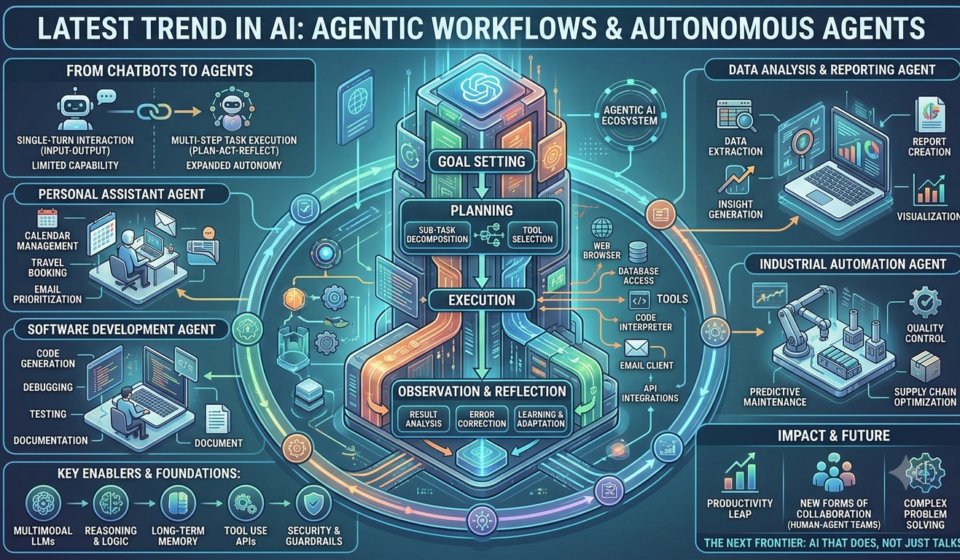
1. Agentic AI & Autonomous Workflows
AI is shifting from passive assistants to proactive agents capable of planning, reasoning, executing multi-step tasks, and using tools autonomously.
-
Tool Use & API Integration: AI models can execute code, interact with web platforms, manage databases, and operate enterprise software without human intervention at every step.
-
Multi-Agent Systems: Teams of specialized AI agents collaborate—where one agent researches, another writes code, and a third conducts Quality Assurance—to complete complex projects.
2. Advanced Multimodality & Real-Time Voice
Multimodal AI is no longer just processing text and images separately; models natively process audio, video, vision, and text simultaneously in real time.
-
Low-Latency Voice Interactions: Models can converse with human-like vocal inflections, interruptibility, and emotion recognition.
-
Spatial & Video Understanding: Real-time visual reasoning allows AI to analyze live video feeds for robotics, AR glasses, and automated video editing.
3. Reasoning & Chain-of-Thought Models
Frontier models are emphasizing test-time compute and deliberate reasoning for complex math, coding, and scientific logic.
-
Rather than instantly generating answers, models use internal chain-of-thought processing to evaluate multiple hypotheses, double-check logic, and fix errors before responding.
-
This dramatically reduces hallucinations in high-stakes fields like legal discovery, financial modeling, and software engineering.
4. Edge AI & Small Language Models (SLMs)
While frontier cloud models continue to scale, there is a parallel rise in highly efficient Small Language Models (SLMs) running locally.
-
On-Device Intelligence: Models running directly on smartphones, laptops, and IoT devices offer lower latency, offline capability, and enhanced data privacy.
-
Cost Efficiency: Fine-tuned smaller models (1B to 8B parameters) match or exceed older large models on specific task-based benchmarks at a fraction of the compute cost.
5. Open-Source & Model Democratization
The performance gap between proprietary models (like OpenAI, Anthropic, Google) and open-weights models (like Meta’s Llama series, DeepSeek, Qwen, Mistral) continues to narrow.
-
Enterprises are opting for self-hosted open-source models to maintain total data sovereignty and avoid vendor lock-in.
6. AI Safety, Governance & Watermarking
With AI-generated content flooding digital ecosystems, governance and verification are becoming critical infrastructure.
-
Provenance Standards: Adoption of cryptographic watermarking (like C2PA) to verify authentic vs. AI-synthesized media.
-
Regulation & Compliance: Compliance frameworks around the EU AI Act, risk management, and bias mitigation in automated decision-making systems.