
Rupee Nears ₹96 to Dollar: Reasons Behind High Oil Prices Weakening Indian Rupee
The Indian rupee hit its lowest level in two months at ₹96 against the US dollar, as oil prices surged. Here’s why oil is so important for India’s currency.
Key Highlights:
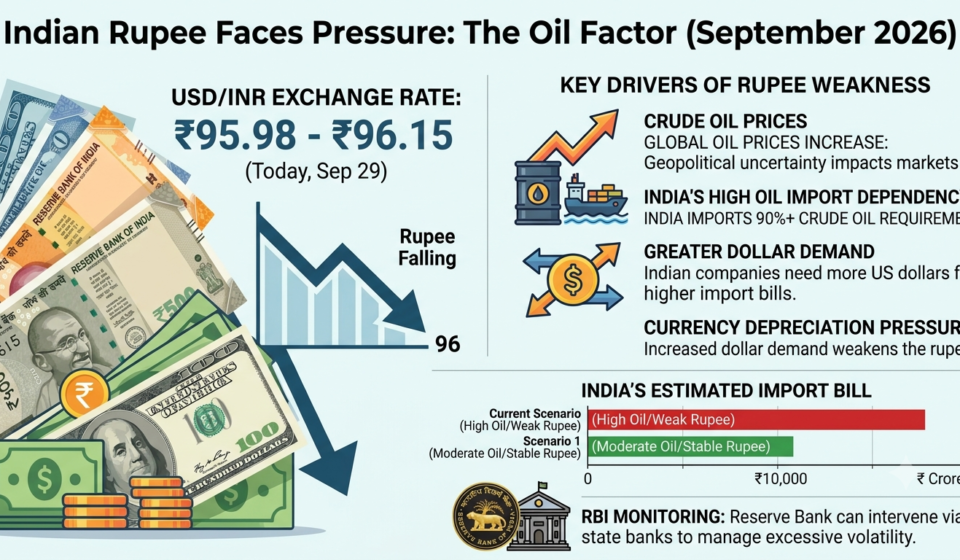
- Exchange Rate: The Indian rupee touched a low of ₹96.15 per US dollar before closing around ₹95.98.
- Primary Driver: Rising global crude oil prices driven by escalating geopolitical tension.
- Central Bank Action: The RBI likely intervened via state-run banks to sell dollars and curtail extreme market volatility.
The Indian rupee came under renewed pressure on September 29, touching an intra-day low of ₹96.15 against the US dollar before closing the session near ₹95.98. The sharp movement was largely triggered by a surge in international crude oil prices following heightened global geopolitical uncertainty—a development that directly impacts energy-dependent economies like India.
Why Crude Oil Moves the Rupee
India depends on imports for roughly 90% of its crude oil requirements. Because global energy markets conduct transactions in US dollars, Indian oil refiners and importers must convert rupees to dollars to clear their import bills.
When crude prices escalate, the quantity of dollars needed to settle energy contracts surges. This creates a sharp imbalance in the foreign exchange market:
Higher Crude Prices –> Expanded Import Bill –> Elevated Dollar Demand –> Rupee Depreciation
Impact on Businesses and Consumers
While a falling currency does not trigger immediate retail price spikes across all sectors, sustained pressure can elevate overall input costs over time.
| Affected Industry / Sector | Impact Mechanism |
| Electronics & Machinery | Higher costs for imported components and capital equipment |
| Pharmaceuticals | Increased expenditure on active pharmaceutical ingredients (APIs) |
| Chemicals & Plastics | Higher landed costs for raw petroleum-derived feedstocks |
| Logistics & Freight | Eventual passthrough of higher transport and energy operational costs |
Will Domestic Petrol and Diesel Prices Rise?
A weaker rupee does not translate into an immediate one-for-one jump at domestic fuel stations. Local retail prices are determined by a combination of international benchmark prices, refining margins, currency rates, and state/central tax structures. Short-term currency fluctuations are frequently absorbed by refining margins or tax adjustments rather than immediate consumer price revisions.
RBI Intervenes to Limit Volatility
To prevent disorderly market movements and currency speculation, the Reserve Bank of India (RBI) routinely monitors the foreign exchange market. Market sources noted that state-run banks were selling dollars in the market during the session—likely acting on behalf of the central bank—to smooth volatility and cap the rupee’s downward drift.
What Lies Ahead
The near-term trajectory of the rupee will remain tied to several key global parameters:
- Crude oil price trends and supply stability in major producing regions.
- Monetary policy stances of major global central banks, particularly the US Federal Reserve.
- Capital flows into Indian debt and equity markets by foreign institutional investors (FIIs).
For India’s macroeconomic outlook, international oil price behavior remains the most critical external variable to watch in the coming quarters.
Source: Reuters reported the rupee’s September 29 movement and the role of crude oil and RBI intervention.


[…] the US dollar, while global yields and energy prices have also been important market factors. India’s rupee has recently been trading near ₹96 against the US dollar, adding another layer to the RBI’s policy […]