

Feeling stuck in life? Discover 10 practical ways to start over, rebuild your routine, regain direction and create a realistic 30-day life reset plan.
Have you ever felt like you have so many things you want to do, so many plans in your head, but somehow you are not doing any of them?
You wake up thinking that today will be different. You’ll fix your routine, start working on your goals, exercise, eat better, learn something new and finally become consistent.
But then the day passes.
Tomorrow becomes another Monday, next week becomes another fresh start, and somehow you find yourself in exactly the same place.
If this sounds familiar, you are not alone.
Sometimes, feeling stuck in life has nothing to do with a lack of dreams or ambition. You might have plenty of ideas but feel overwhelmed by where to begin. You may be comparing your current situation with where you thought you would be by now.
And that can make starting anything feel difficult.
But here’s something worth remembering: You don’t have to change your entire life in one day. You can start rebuilding it one small decision at a time.
In this guide, we’ll explore why people feel stuck, how to reset your routine, how to regain direction and how to start making progress without putting unnecessary pressure on yourself.
Why Do You Feel Stuck in Life?
Before trying to change your routine, it helps to understand what might be making you feel stuck.

There isn’t always one specific reason. Sometimes several things happen together, making it difficult to move forward.
1. You Have Too Many Ideas but No Clear Direction
You want to learn a new skill, start a business, improve your fitness, create content, travel, save money and work on yourself.
Every idea feels exciting initially.
But when everything becomes a priority, deciding what to do first becomes difficult.
You spend more time thinking about possibilities than actually working on one of them.
What helps: Choose one or two priorities instead of trying to pursue every idea simultaneously.
2. You Keep Comparing Your Life With Others
Social media makes it incredibly easy to compare your everyday life with someone else’s highlights.
Someone your age might have a successful career, a beautiful home, a growing business or an exciting lifestyle.
Meanwhile, you might feel like you’re still figuring things out.
But remember that you are comparing your behind-the-scenes moments with someone else’s carefully selected highlights.
People have different starting points, responsibilities, opportunities and timelines.
Your progress does not become meaningless just because someone else reached a milestone earlier.
3. You Are Waiting for the Perfect Time
You might be waiting for Monday, the first day of the month, a new year or the moment when you finally feel motivated.
But motivation is unpredictable.
Some days you feel energetic and ready to do everything. On other days, even getting started feels like a task.
Waiting for the perfect mood can keep you in the same cycle.
What helps: Start with something small, even if you don’t feel completely ready.
4. Your Routine Has Lost Its Structure
When your daily routine becomes irregular, it can become harder to maintain consistency.
Sleeping late, waking up at different times, spending hours scrolling and postponing important tasks can make your days feel disorganised.
You don’t necessarily need a strict 5 AM routine.
You need a routine that gives your day some direction.
5. You Are Mentally Exhausted
Sometimes, feeling stuck is not about laziness or poor time management.
You may be dealing with prolonged stress, uncertainty, emotional exhaustion or difficult life changes.
Trying to force yourself into an extremely productive routine might make things worse.
If these feelings are persistent, affect your everyday functioning or feel overwhelming, consider talking to a qualified mental health professional.
Rest and support are also important parts of moving forward.
10 Practical Ways to Start Over in Life
Starting over doesn’t mean abandoning everything you have done so far.
It means taking a closer look at your current situation and deciding what you want to do differently.
Here are ten practical ways to begin.
1. Stop Trying to Fix Everything at Once
One of the biggest mistakes people make when restarting their lives is creating an unrealistic list of changes.
They decide to:
- Wake up at 5 AM.
- Exercise every day.
- Stop using social media.
- Learn a new skill.
- Start earning more money.
- Read books.
- Eat healthy.
- Become completely disciplined.
All at once.
The problem isn’t that these goals are bad. The problem is trying to change too many habits simultaneously.
Instead, choose three priorities for now.
For example:
- Improve your sleeping routine.
- Spend one hour learning a useful skill.
- Take a 20-minute walk every day.
Once these become manageable, gradually introduce other habits.
2. Clean Up Your Physical and Digital Space
Your surroundings can influence how easy or difficult it feels to begin a task.
You don’t need an expensive room makeover or a completely new workspace.
Start with simple things:
- Make your bed.
- Clear your desk.
- Organise your wardrobe.
- Remove unnecessary files from your laptop.
- Unfollow accounts that constantly make you feel inadequate.
- Turn off unnecessary notifications.
A clean, organised environment can make it easier to focus on what matters.
You don’t need to finish everything in one day. Even organising one corner of your room is a beginning.
3. Create a Simple Morning Routine
A productive morning doesn’t have to look like a perfectly edited lifestyle video.
You don’t need to wake up before sunrise to have a meaningful day.
Try creating a routine that works with your actual schedule.
For example:
| Activity | Suggested time |
|---|---|
| Wake up and freshen up. | 15 minutes |
| Drink water and get some sunlight. | 10 minutes |
| Light stretching or walking | 20 minutes |
| Breakfast | 20 minutes |
| Plan the day’s priorities. | 10 minutes |
The goal is not to complete a long checklist.
The goal is to start your day with intention instead of immediately reaching for your phone.
4. Make a List of What You Actually Want
Sometimes we follow goals simply because we see other people achieving them.
But have you ever stopped to ask yourself what you genuinely want?
Take a notebook and divide a page into four sections:
- Personal growth.
- Career and money.
- Health and lifestyle.
- Relationships and experiences.
Write down what you want in each area.
Then ask yourself:
- Why do I want this?
- Is this important to me?
- What is one action I can take this week?
- Am I trying to achieve this for myself or to impress someone else?
This exercise can help you separate your own priorities from outside expectations.
5. Start With the 20-Minute Rule
If a task feels overwhelming, reduce the amount of time you expect yourself to work on it.
Instead of saying, “I need to learn an entirely new skill,” say:
“I will spend 20 minutes learning one concept today.”
Instead of planning a complete fitness transformation, start with a 20-minute walk.
Instead of trying to write an entire article, write the introduction.
The purpose is to make starting easier.
Once you begin, you may naturally decide to continue. And even if you stop after 20 minutes, you have still made progress.
6. Stop Waiting for Motivation
Motivation is helpful, but it isn’t a reliable daily system.
Some days you will feel excited about your goals. Other days you may not want to do anything.
This is where small routines become useful.
For example, if you want to develop a reading habit, keep your book somewhere visible and read two pages daily.
If you want to exercise, keep your walking shoes ready.
If you want to create content, maintain a list of ideas so you don’t have to start thinking from zero every time.
Make the desired action easier to begin.
7. Reduce Mindless Scrolling
You might pick up your phone to check one notification and suddenly realise that an hour has passed.
Social media can be entertaining and useful, but excessive scrolling can take time away from activities you actually want to do.
Try these small changes:
- Avoid checking your phone immediately after waking up.
- Set limits for apps where you lose track of time.
- Keep your phone away during focused work.
- Unfollow accounts that make you feel unnecessarily pressured.
- Replace some scrolling time with reading, walking or learning.
You don’t have to quit social media.
You just need to become more intentional about how you use it.
8. Build One Skill That Can Improve Your Future
If you feel stuck professionally or financially, learning a useful skill can be a practical starting point.
You don’t need to learn everything at once.
Depending on your interests, you could explore:
- Content writing.
- Graphic design.
- Video editing.
- Digital marketing.
- Data analysis.
- Artificial intelligence tools.
- Communication skills.
- Website development.
Choose something that connects with your interests and career goals.
Spend a little time learning and, more importantly, create something using that skill.
Practical experience is often more useful than endlessly collecting courses.
9. Celebrate Small Progress
We often wait for big achievements before allowing ourselves to feel proud.
But progress is not limited to promotions, income, followers or major milestones.
It can also mean:
- Getting out of bed when you didn’t feel like it.
- Completing a task you had postponed.
- Taking your first walk after several inactive days.
- Finishing a book.
- Applying for a job.
- Saying no to something that wasn’t good for you.
Recognising small progress can help you stay connected to your goals.
You don’t need to turn every day into a success story. You just need to acknowledge that your efforts count.
10. Give Yourself Permission to Begin Again
You will have unproductive days.
You might miss your workout, postpone a task or return to an old habit.
That doesn’t mean your entire effort has failed.
One missed day does not erase the progress you have already made.
Instead of waiting for another Monday or another month, return to your routine with the next opportunity.
Consistency is not about being perfect every day. It’s about learning how to continue after interruptions.
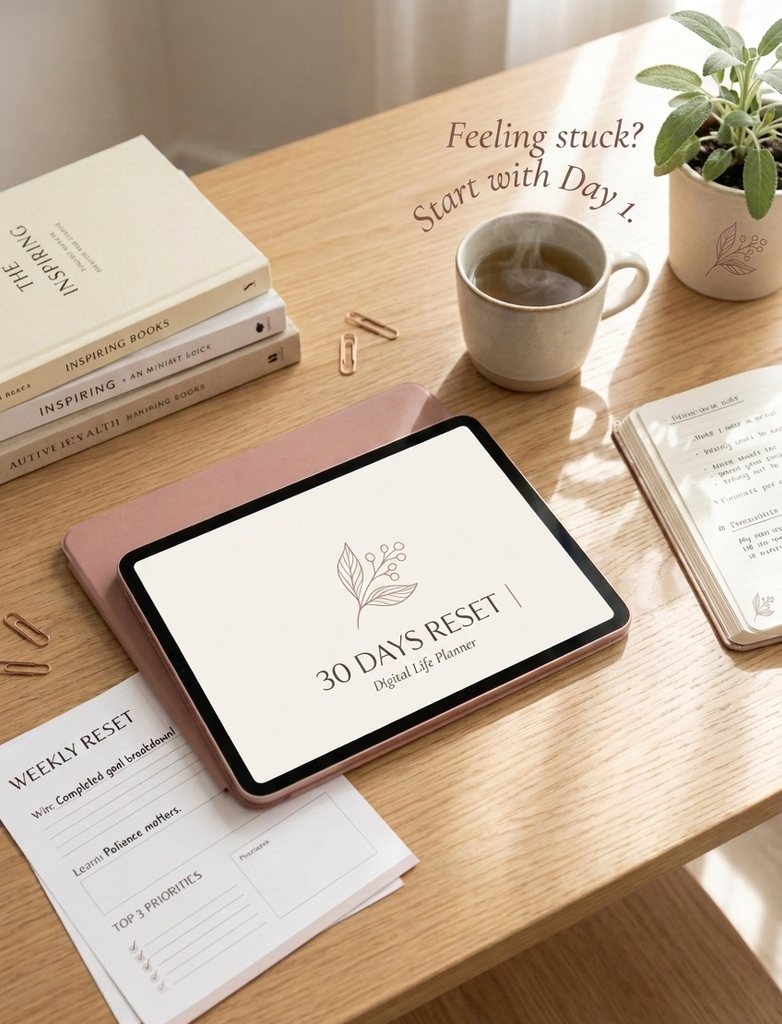
How to Reset Your Life in 30 Days
If you want a structured way to begin, try this simple 30-day reset challenge.
“Use a 30-Day Reset Planner to organize your goals, daily priorities and habits.”
The purpose is not to transform your life in a month. It is to build a foundation that you can continue using afterwards.
Week 1: Declutter and Understand Yourself
Focus on creating clarity.
- Clean your personal space.
- Organize your phone and laptop.
- Write down your current priorities.
- Identify habits that are taking too much of your time.
- Decide what you want to change.
Goal: Understand where you are and what needs attention.
Week 2: Build a Better Routine
Focus on simple daily habits.
- Choose a consistent waking time.
- Include some physical activity.
- Plan your three main tasks.
- Reduce unnecessary screen time.
- Create a relaxing bedtime routine.
Goal: Give your days a little more structure.
Week 3: Focus on Personal Growth
Start working towards something meaningful.
- Learn a new skill.
- Read or listen to educational content.
- Work on a career or personal project.
- Review your financial habits.
- Make time for activities you enjoy.
Goal: Start investing time in your future.
Week 4: Review and Build Consistency
Use the final week to understand what is working.
- Review your progress.
- Identify habits you can realistically maintain.
- Remove unnecessary goals.
- Celebrate your efforts.
- Create a plan for the next 30 days.
Goal: Build a routine you can continue beyond the challenge.
A Simple Daily Reset Checklist
You can use this checklist to keep your day manageable.
| Daily habit | Suggested target |
|---|---|
| Wake up at a consistent time | Daily |
| Drink enough water | Throughout the day |
| Move your body | 20 minutes |
| Work on one important goal | 30–60 minutes |
| Learn something useful | 20 minutes |
| Reduce unnecessary scrolling | Daily |
| Write down your thoughts | 5 minutes |
| Prepare for tomorrow | 10 minutes |
Adjust these targets according to your lifestyle, health and responsibilities.
Remember, missing one habit doesn’t mean you have failed the entire day.
What If You Still Feel Stuck After Trying Everything?
This is an important part of the conversation.
Sometimes, even after organizing your routine, setting goals and trying different habits, you may still feel stuck.
That’s okay.
Not every difficult phase can be solved through productivity techniques.
You may need more rest, a change in circumstances, emotional support or time to understand what you actually want.
Avoid treating every difficult emotion as a problem that needs to be fixed immediately.
If you have been experiencing persistent sadness, hopelessness, exhaustion or difficulty functioning, reaching out to a mental health professional can be a helpful step.
You are allowed to ask for support while working towards a better life.
Final Thoughts: You Don’t Need a New Life, You Need a New Starting Point
Starting over can feel intimidating, especially when you believe you should already have everything figured out.
But life rarely follows a perfectly organized timeline.
Sometimes you make progress. Sometimes you pause. Sometimes your priorities change, and sometimes you need to rethink the direction you were taking.
None of that makes your journey meaningless.
Instead of waiting for the perfect Monday, the perfect month or the perfect version of yourself, begin with one small action today.
Clean your space. Take a walk. Write down your thoughts. Finish one postponed task. Spend 20 minutes working on something that matters to you.
And tomorrow, try again.
You are not behind just because your life looks different from what you imagined. You are allowed to rebuild, change direction and begin again.
Your next chapter doesn’t need a perfect beginning. It just needs a beginning.
Frequently Asked Questions (FAQs)
1. How do I start over in life when I feel completely lost?
Start by understanding what is making you feel lost. Write down your current concerns, identify what you can control and choose one small action to take today. Avoid making too many major changes simultaneously.
2. How can I restart my life with no motivation?
Don’t wait for motivation to appear. Choose a task that takes only 5–20 minutes and make it easy to begin. Small, manageable actions can help you gradually rebuild a routine.
3. Is it too late to start over in life?
No. People change careers, develop new skills, rebuild routines and discover new interests at different ages. Your timeline does not have to match anyone else’s.
4. How long does it take to reset your life?
There is no fixed timeline. A 30-day reset can help you organize your priorities and experiment with healthier routines, but meaningful changes may take longer.
5. What should I do first when my life feels messy?
Start with the basics. Organize your immediate surroundings, get enough rest, identify your biggest priorities and complete one manageable task. You don’t need to solve everything immediately.
6. How do I become consistent in life?
Start with realistic habits, connect them to an existing routine and track your progress. When you miss a day, return to the habit rather than abandoning it completely.
7. Can a 30-day challenge really change your life?
A 30-day challenge can help you experiment with new habits, improve awareness and create structure. However, lasting changes require continued effort beyond the initial challenge.
8. How do I stop comparing my life with others?
Limit exposure to content that creates unnecessary pressure, focus on your own goals and measure progress against your previous efforts rather than someone else’s achievements.
At India Nudge, we believe personal growth is not about becoming perfect. It’s about making informed choices, building better habits and creating a life that feels meaningful to you.