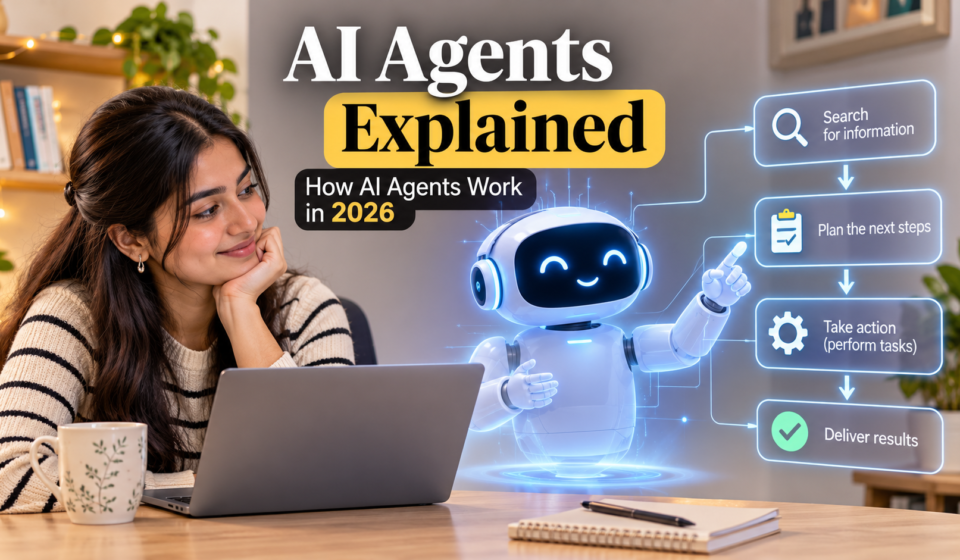
AI Agents Explained: What They Are, How They Work and What They Can Do in 2026

Artificial intelligence is moving beyond answering questions.
Until recently, most people used AI tools to write emails, generate images, summarize documents or find information. You asked a question, received an answer and decided what to do next.
But a newer development is changing how people interact with AI: AI agents.
Imagine telling an AI system, “Help me organize my work for this week.”
Instead of simply suggesting a timetable, an AI agent could review your tasks, organize priorities, check your calendar, prepare a schedule and create reminders using the tools you allow it to access.
That’s the idea behind AI agents.
They don’t just generate responses. They can work through multiple steps, use connected tools and take actions to achieve a particular goal.
But what exactly are AI agents? Are they different from ChatGPT? Can they really work independently? And how useful are they for students, creators, businesses and everyday users?
Let’s understand everything in simple terms.
What Are AI Agents?
An AI agent is a software system that uses artificial intelligence to understand a goal, plan the steps needed to achieve it and perform actions using available tools.
Unlike a traditional chatbot that mainly responds to individual questions, an AI agent can handle a series of connected tasks.
For example:
- A chatbot can suggest ways to organize your emails.
- An AI agent with suitable email access could categorize messages, identify important emails and prepare replies for review.
- With additional permissions, it might also perform approved actions.
The important difference is that an agent can move beyond providing suggestions and interact with other systems.
AI agents commonly use large language models (LLMs), instructions, context, memory, planning and external tools to complete tasks.
However, not every AI agent has all these capabilities. Its actual abilities depend on how it is designed, which tools it can access and what permissions it receives.
How Do AI Agents Work?
You don’t need a technical background to understand how AI agents work.
Think of an AI agent as a digital assistant that follows a process rather than simply answering one question.
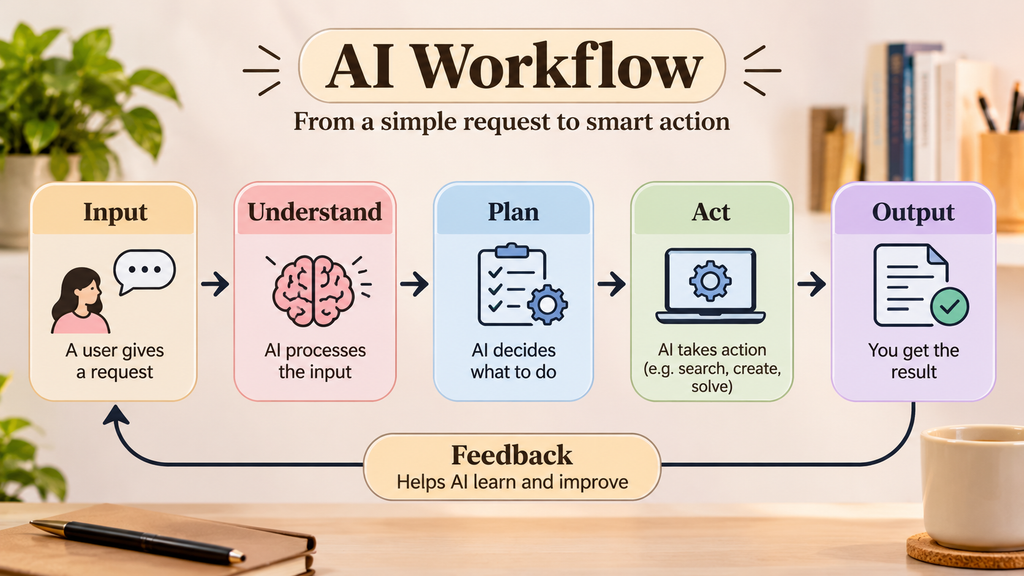
Most modern AI agent systems follow a cycle involving these steps.
1. Understanding the Goal
First, the agent receives an instruction from the user.
For example:
“Find five suitable topics for my technology blog and prepare an article plan.”
The agent interprets what you want and identifies the expected result.
2. Breaking the Task Into Smaller Steps
A larger task can be divided into smaller activities.
For the blog example, the agent might:
- Identify the target audience.
- Research relevant technology topics.
- Compare possible topics.
- Organize them by search intent.
- Prepare an article outline.
This process is called task planning or task decomposition.
3. Using Tools and Information
This is where AI agents become particularly useful.
Depending on their permissions and integrations, agents can use external tools such as:
- Search engines and research tools.
- Spreadsheets and databases.
- Email and calendar applications.
- Business software.
- APIs and automation platforms.
- File management systems.
An AI model without external tools may only generate suggestions. An agent connected to the right tools can use information and perform actions outside the conversation.
4. Taking Action
Once the agent has identified what needs to be done, it can execute the permitted steps.
For example, it could organize information in a spreadsheet, create a draft document or prepare calendar entries.
Some actions may happen automatically within the permissions granted. Others should require user approval.
5. Checking the Results
After performing an action, the agent can examine the result and decide what to do next.
If a step fails, it may try another approach, request more information or return control to the user.
This repeated process of observing, deciding, acting and checking is commonly called the agent loop.
AI Chatbots vs AI Assistants vs AI Agents
These terms are often used interchangeably, but they don’t always mean the same thing.
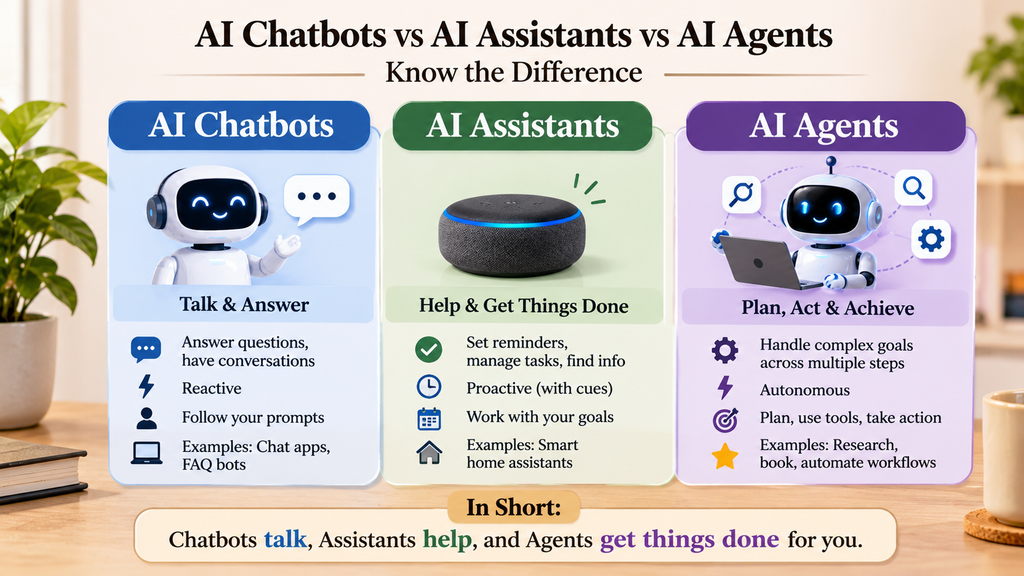
Here’s a simple comparison.
| Feature | AI Chatbot | AI Assistant | AI Agent |
|---|---|---|---|
| Main purpose | Answer questions | Help users with tasks | Achieve defined goals |
| Interaction | Mostly conversational | Interactive assistance | Goal-oriented execution |
| Planning | Usually limited | May support planning | Can plan multiple steps |
| External tools | Sometimes | Often | Used to gather information or take action |
| Independence | Usually low | Varies | Can operate with greater autonomy |
For example:
AI chatbot: You ask how to prepare for an interview. It gives you interview tips.
AI assistant: You ask for interview questions and practice answers. It helps you prepare.
AI agent: With appropriate access, it could research a company, organize likely interview topics, prepare a practice schedule and create reminders.
One important point: these categories overlap. An AI assistant can also be agentic, and the word “agent” does not automatically mean a system can do everything independently.
What Can AI Agents Actually Do in 2026?
AI agents are being explored and used across several industries. Their usefulness depends on the task, available tools, reliability and human supervision.
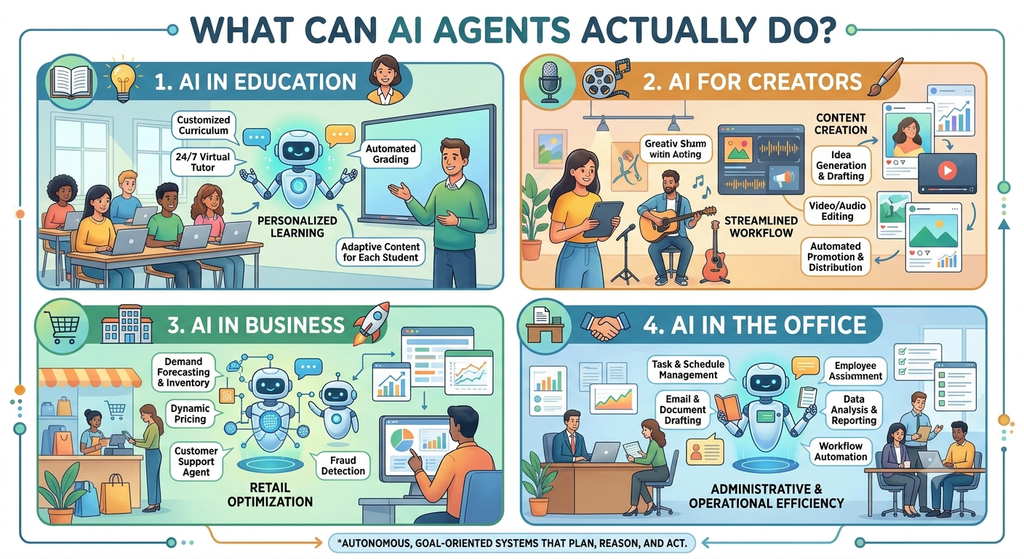
Here are some practical examples.
1. AI Agents for Students
Students can use agent-based systems to organize learning activities.
Possible uses include:
- Creating a study timetable.
- Organizing assignment deadlines.
- Preparing revision plans.
- Finding learning resources.
- Generating practice questions.
- Tracking completed tasks.
For example, a student preparing for board examinations could use an agent to organize subjects, divide chapters into daily targets and prepare a revision schedule.
The student still needs to understand the material and verify the information.
2. AI Agents for Content Creators
Content creation involves much more than recording a video or writing a caption.
Creators often manage research, scripting, editing, publishing and performance tracking.
An AI agent with suitable integrations could help with:
- Organizing content ideas.
- Researching topics.
- Preparing content calendars.
- Drafting scripts and captions.
- Organizing files.
- Reviewing performance data.
- Preparing reports.
Imagine having a weekly content workflow prepared using one goal instead of manually organizing every step.
“AI tools for content creation”
However, creativity, originality and understanding your audience still require human judgment.
3. AI Agents for Small Businesses
Small businesses often spend significant time handling repetitive activities.
AI agents can help with tasks such as:
- Sorting customer enquiries.
- Organizing order information.
- Preparing customer-support responses.
- Updating records.
- Tracking business tasks.
- Creating routine reports.
For example, an online store could use an agent to identify unanswered customer enquiries and prepare suitable responses.
Before sending messages, changing orders or processing refunds, businesses should establish appropriate approval rules.
4. AI Agents for Office Work
Office professionals can use agents to simplify repetitive administrative tasks.
Depending on the software integrations, an agent might:
- Summarize meeting notes.
- Extract important dates from documents.
- Prepare email drafts.
- Organize project information.
- Update spreadsheets.
- Create task lists.
This can reduce the time spent moving information between different applications.
5. AI Agents for Research
Research often involves collecting information from multiple sources, comparing findings and organizing results.
An AI agent can help with:
- Finding relevant sources.
- Collecting information.
- Comparing different options.
- Organizing findings.
- Preparing research summaries.
However, research outputs should always be checked against the original sources. An agent can misunderstand information, overlook important evidence or present incorrect conclusions.
Examples of AI Agent Platforms and Technologies
If you want to explore AI agents, there are several platforms and technologies worth understanding.
1. ChatGPT
ChatGPT can help with research, planning, writing and multi-step tasks. Depending on the available tools and features, it can also interact with connected services and perform actions.
It is useful for people who want to explore AI-assisted workflows without building an agent from scratch.
2. Google Gemini
Google Gemini offers AI capabilities across Google’s ecosystem. Depending on the product and integrations available, it can help users work with information and connected services.
3. Microsoft Copilot
Microsoft Copilot provides AI assistance across Microsoft’s products. Microsoft’s agent technologies also support more specialized business workflows.
4. n8n
n8n is a workflow automation platform that supports AI-powered workflows and agent integrations.
It can be useful for people who want to connect different applications and automate processes with more control over how each step works.
5. LangChain
LangChain provides development frameworks and tools for building applications powered by language models, including agent-based systems.
It is more suitable for developers and people interested in creating customised AI applications.
Important: These platforms do not all serve the same purpose. Some are ready-to-use AI products, while others are development or automation tools. Their agent capabilities, availability and pricing can differ.
Benefits of Using AI Agents
AI agents can be useful because they help move work from individual tasks to connected workflows.
Some potential benefits include:
1. Saving time: Repetitive activities can be handled with fewer manual steps.
2. Managing complex tasks: Larger goals can be divided into smaller activities and handled in sequence.
3. Connecting applications: Agents can work across supported tools and systems.
4. Improving productivity: People can spend less time on routine administration and more time on important work.
5. Supporting decision-making: Agents can collect and organize information to help users compare options.
However, these benefits are not guaranteed. Poor instructions, incorrect information, missing integrations or unreliable actions can reduce the value of an agent.
Risks and Limitations of AI Agents
AI agents sound exciting, but giving software the ability to take actions also introduces risks.
Before using one, understand these limitations.
1. Incorrect Information
An AI agent can produce inaccurate information or make incorrect decisions based on incomplete data.
Always verify important information, especially in financial, legal, medical and professional situations.
2. Data Privacy
Some agents need access to emails, files, calendars or business information.
Before connecting an account, check what information the agent can access, how data is handled and whether you can revoke permissions.
Avoid giving unnecessary access to sensitive documents or personal information.
3. Unwanted Actions
An agent with excessive permissions might make changes you did not intend.
For example, it could modify a file, send an incorrect message or update a record.
For sensitive activities, use approval requirements before allowing actions to be completed.
4. Security Threats
AI agents can encounter malicious instructions hidden in webpages, emails or documents. This is one reason security controls are important.
Never assume that everything an agent reads is trustworthy.
5. Human Oversight Is Still Necessary
AI agents are not perfect employees who can be trusted with every responsibility.
People still need to define goals, check important decisions and take responsibility for the final outcome.
Should Beginners Start Using AI Agents?
Yes, but start with small and low-risk tasks.
You don’t need to build a complicated automation system to understand the technology.
Try these beginner-friendly activities:
- Ask an AI assistant to organize your weekly tasks.
- Let it prepare a content calendar.
- Use it to organize research for a project.
- Ask it to prepare a study timetable.
- Experiment with a simple workflow that connects two applications.
Initially, keep actions in draft or review mode. Once you understand how the system works, you can decide whether to allow additional permissions.
You should also compare the available free and paid features before subscribing to any platform.
What Is the Future of AI Agents?
AI agents are an important development in artificial intelligence because they extend AI from generating information to carrying out workflows.
As these systems become more capable, we may see more specialized agents working in education, customer service, research, business operations and personal productivity.
Multi-agent systems are another area of development. Instead of relying on one agent for everything, multiple specialized agents can work together on different parts of a larger task.
For example, a business workflow might involve:
- One agent researching customer requirements.
- Another organizing product information.
- A third preparing a report.
- A human reviewing the final result.
This approach can make complicated workflows easier to organize, although coordination, security and accuracy remain important challenges.
The future of AI agents will not depend only on how intelligent the models become. It will also depend on how safely and reliably they interact with real-world systems.
Final Thoughts
AI agents represent a shift in how we use artificial intelligence.
Instead of asking AI to complete one small task at a time, we can increasingly give it a goal and let it work through the steps required to achieve that goal.
For students, creators, professionals and small business owners, this could mean less time spent on repetitive work and more time available for learning, creativity and decision-making.
But remember: more automation does not always mean better results.
The smartest approach is to understand what an AI agent can do, give it only the permissions it needs and review important actions before they are finalized.
AI agents are not here to replace your thinking. They are tools that can help you put your thinking into action.
Frequently Asked Questions (FAQs)
1. What is an AI agent in simple words?
An AI agent is a software system that understands a goal, plans the steps needed to achieve it and uses available tools to perform tasks with varying levels of independence.
2. Is ChatGPT an AI agent?
ChatGPT is an AI assistant that can also perform agent-like tasks through supported tools and features. Whether a particular interaction is agentic depends on the capabilities being used.
3. What is the difference between AI agents and chatbots?
Traditional chatbots mainly respond to user questions. AI agents can go further by planning and carrying out multiple connected actions using external tools.
4. Can AI agents work without human supervision?
Some AI agents can perform permitted tasks independently, but their autonomy depends on their design and permissions. Human supervision is especially important for sensitive or irreversible actions.
5. Are AI agents free to use?
Some platforms offer free access or limited free features, while others require paid subscriptions or usage-based payments. Pricing depends on the platform and the features you need.
6. Can AI agents replace human jobs?
AI agents can automate certain activities and change how some jobs are performed. However, their capabilities vary, and human judgment, communication, creativity and accountability remain important.
7. Are AI agents safe?
They can be useful, but safety depends on data access, permissions, security controls and human oversight. Avoid giving agents unrestricted access to sensitive accounts or information.
8. What is a multi-agent system?
A multi-agent system uses multiple AI agents that collaborate on different parts of a task or shared goal. Each agent may have a specialized role.
Explore more practical AI guides on India Nudge and learn how to use technology more effectively in everyday life.


[…] “How AI agents interact with connected applications” […]
[…] AI agents and how they work […]