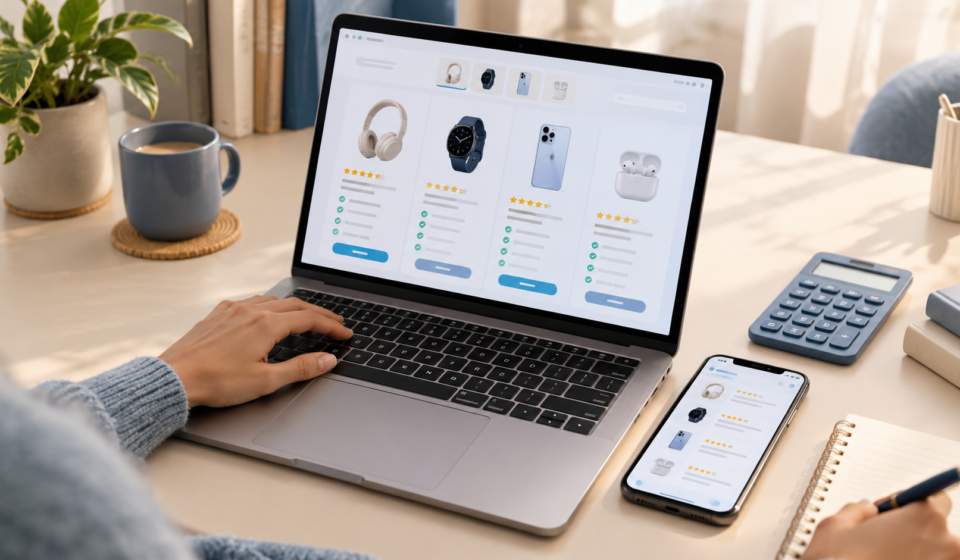

You see a product listed at ₹4,999, a big red discount badge, and a final price of ₹2,499. 👀
Your brain immediately goes: “Half price? I should buy it before the offer ends!”
But wait a second.
What if the product was already selling for around ₹2,499 before the sale? What if another website offers it for less? And what if the bank offer everyone is talking about doesn’t apply to your card?
Welcome to online shopping in 2026, where finding a discount is easy—but figuring out whether it is a genuine deal takes a little more attention.
The good news? You don’t need to be a shopping expert. You just need to check a few things before clicking Buy Now.
1. Don’t Trust the Discount Percentage Blindly
A product marked 70% off sounds more exciting than one marked 20% off. But a bigger percentage doesn’t automatically mean a better deal.
Imagine these two offers:
| Product | Displayed price | Sale price |
|---|---|---|
| Product A | ₹5,000 | ₹3,000 |
| Product B | ₹3,500 | ₹2,800 |
Product A advertises a 40% discount, while Product B advertises a 20% discount. Yet Product A costs ₹200 more.
And there’s another catch: the displayed original price may be an MRP or reference price, not necessarily what shoppers regularly paid before the sale.
The smarter question isn’t “How much am I saving?” It’s “Is this a good price for this product?”
Start with the final selling price, not the biggest discount badge.
2. Check the Product’s Price History
This is one of the most useful habits you can develop as an online shopper.
A product’s price may change throughout the year because of sales, stock levels, seasonal demand, new launches, and promotional campaigns.
Before buying an expensive product, try to find out whether its current price is genuinely attractive compared with its recent prices.
You can:
- Check price-tracking tools, where historical data is available.
- Compare the current price with earlier recorded prices.
- Look at the same product during previous major sale periods, if records are available.
- Check whether the current offer is lower than the product’s usual selling price.
Tools such as Buyhatke may help you check price history and compare offers. Features and historical coverage can vary by product and store, so verify the information shown for the item you’re considering.
Remember: A historical low doesn’t guarantee the product is the right purchase for you. It simply gives you more context before deciding.
3. Compare Prices Across Different Stores
Found a great deal on one website? Give yourself another minute before paying.
Check the same product on other reputable retailers and, where relevant, the brand’s official website.
For a fair comparison, make sure you’re looking at the exact same:
- Model and model number
- Storage or memory configuration
- Size, colour, or variant
- Pack quantity
- Warranty and included accessories
A phone with 128 GB of storage isn’t the same deal as a 256 GB version. Similarly, two products with similar names may have different specifications.
Also compare the seller, delivery fee, return conditions, and estimated delivery date.
A lower price isn’t automatically better if the product has different specifications or less favourable purchase conditions.
4. Calculate the Actual Final Price
This is where some supposedly amazing deals become less exciting.
The displayed product price may not include every cost or account for every offer condition.
Use this simple formula:
Final price = product price + delivery charges + mandatory fees − eligible discounts
For example, imagine you’re buying a product with these costs:
| Item | Amount |
|---|---|
| Product price | ₹3,000 |
| Delivery charge | ₹100 |
| Eligible coupon discount | −₹200 |
| Final price | ₹2,900 |
The product’s displayed price is ₹3,000, but your actual cost is ₹2,900 after delivery and the coupon.
Now compare that final amount with other stores—not just their headline prices.
Before paying, check the checkout page carefully. Some discounts may require a minimum order value, a specific payment method, or a coupon that must be applied manually.
5. Understand Bank Offers and Cashback
“Extra 10% off with selected bank cards!” sounds great. But it might not be available to everyone.
Some offers require a particular card type, a minimum purchase amount, a maximum discount limit, or payment through a specified method.
Cashback can also work differently from an instant discount. It may be credited later, subject to eligibility, terms, and processing timelines.
Before counting a bank offer as a saving, ask:
- Does my card qualify?
- Is there a minimum transaction amount?
- Is the discount capped?
- Does it apply to this exact product?
- Is the benefit an instant discount or later cashback?
- Are there any additional conditions?
Calculate what you will actually pay today. Treat future cashback separately until you’ve checked its terms.
And don’t spend extra money just to unlock an offer unless the additional purchase makes sense on its own.
6. Don’t Let Countdown Timers Make the Decision
⏰ “Only 5 minutes left!”
🔥 “Deal ending soon!”
⚡ “Limited stock!”
These messages can create pressure to buy immediately. Sometimes an offer really is time-limited or stock is genuinely running low. But a countdown alone doesn’t prove that a deal is exceptional.
If you weren’t planning to buy the product before seeing the timer, pause.
Ask yourself:
- Did I already need this product?
- Have I checked its price elsewhere?
- Do I know whether the offer is competitive?
- Would I still want it if the countdown disappeared?
If you need the product and have verified the price, a time-limited offer may be worth taking.
If you’re buying only because you’re afraid of missing out, waiting could save you more than the discount.
7. Check the Seller, Warranty and Return Policy
Price matters—but so does the experience after you pay.
Before placing an order, review the seller’s ratings and recent customer feedback. Look for repeated complaints about damaged products, incorrect items, missing accessories, or warranty problems.
For electronics and other expensive purchases, verify:
- Whether the product is new, refurbished, or renewed
- Who provides the warranty
- Whether the seller is authorised, where that matters
- Whether returns or replacements are available
- Whether any return fees or restrictions apply
Read recent reviews for the exact model and seller where possible. Reviews can provide useful clues, but they aren’t a guarantee of quality or authenticity.
A small saving may not be worth the risk if it comes with unclear warranty coverage or restrictive return conditions.
8. Watch Out for the “You Saved ₹2,000” Trap
Let’s say you buy a jacket for ₹2,000 because the website says its original price was ₹4,000.
The website tells you that you saved ₹2,000.
But did you actually save ₹2,000 compared with what you would otherwise have spent? Not necessarily.
If you didn’t need the jacket, you spent ₹2,000 you might have kept. If another reliable store sells the same jacket for ₹1,800, you may not have found the best available price either.
This is why discount labels can be misleading when you focus on the amount supposedly saved instead of the money actually spent.
Try this rule:
A discount is useful only when it helps you buy something you need or genuinely want at a price you’re comfortable paying.
You don’t have to buy something simply because the deal looks attractive.
9. When Is the Best Time to Buy?
There isn’t one perfect time to buy every product. The best moment depends on the item, its demand, new launches, stock levels, and the offers available.
Here are a few practical approaches:
For phones and electronics: Compare specifications and prices, check upcoming launches if relevant, and decide whether you need the product now or can wait.
For fashion: Compare the final price, size availability, fabric details, and return policy. A discount isn’t useful if the item doesn’t fit or meet your needs.
For home appliances: Compare the exact model, installation costs, warranty, delivery, and any exchange conditions.
For everyday essentials: Compare the unit price—such as the price per kilogram, litre, or item—rather than relying only on the package discount.
If you don’t need the product urgently, tracking its price for a while can help you make a more informed decision. Just remember that prices may rise as well as fall.
10. Use the Buy, Wait or Skip Rule
Here’s a simple framework you can use before almost any non-essential online purchase.
🟢 BUY
Consider buying when:
- You genuinely need or want the product.
- You’ve compared the exact product across reliable sellers.
- The final price is competitive.
- The seller, warranty, and return terms are acceptable.
- The purchase fits your budget.
🟡 WAIT
Consider waiting when:
- You’re unsure whether the price is good.
- You haven’t compared other stores.
- The purchase isn’t urgent.
- You want to monitor the price for a little longer.
- You’re waiting for a confirmed offer that could make a meaningful difference.
🔴 SKIP
Walk away when:
- You don’t actually need or want the product.
- The deal only looks attractive because of a huge discount label.
- The purchase would strain your budget.
- The seller or product details raise concerns.
- You’re being pressured into a decision you haven’t thought through.
You don’t need to make every shopping decision complicated. This simple check can help you slow down when a deal looks too tempting.
A Quick Online Shopping Checklist
Before you click Place Order, run through this list:
- I’ve checked the actual selling price.
- I’ve compared the same product across reliable stores.
- I’ve checked price history where data is available.
- I’ve calculated the final checkout price.
- I’ve read the bank offer and cashback conditions.
- I’ve checked the seller, warranty, and return policy.
- I want or need the product beyond the discount.
- The purchase fits my budget.
If you can’t tick every box, it doesn’t automatically mean you shouldn’t buy. It simply means you may need more information before deciding.
Final Thoughts: Shop Smarter, Not Just Cheaper
Online sales can be a great opportunity to save money—but only when you look beyond the discount badge.
Compare prices, check the conditions, calculate the final cost, and give yourself permission to walk away when a deal doesn’t make sense.
And next time a website flashes “70% OFF — LAST CHANCE!” at you, remember: you don’t have to win the race to the checkout.
You just have to make a decision you’re happy with.
The smartest shopper isn’t the person who buys the most discounted products. It’s the person who spends money intentionally.
Shopping tip: Save this checklist and use it before your next big online purchase.
Editorial note: Prices in the examples are illustrative, not current offers. Always verify live prices, product specifications, and promotion terms with the retailer before buying.