RBI Drains Nearly $20 Billion of Surplus Liquidity: What It Means for Banks and Borrowers

RBI Drains Nearly $20 Billion in Surplus Cash: What It Means for Your Wallet and Bank Loans
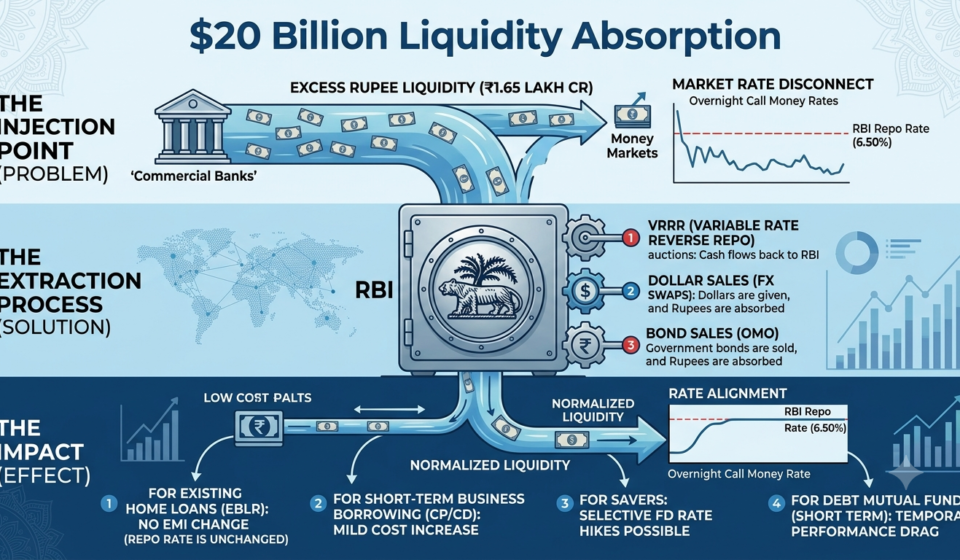
The Reserve Bank of India (RBI) recently pulled nearly $20 billion (around ₹1.65 lakh crore) out of the banking system.
If that sounds like a massive move, it’s because it is. But what does it actually mean for your home loan EMI, your savings account, or small business loans?
Here is a simple, straightforward breakdown of what happened and how it impacts you.
Quick Summary: What Happened?
| Feature | Details |
| What did the RBI do? | Absorbed ~$20 billion (₹1.65 lakh crore) of excess cash from Indian banks. |
| Why did they do it? | Banks had too much idle cash, which was pushing short-term interest rates lower than the RBI wanted. |
| Will loan EMIs rise? | No immediate change for existing retail loans (Home, Car, Personal). |
| Will Fixed Deposits (FDs) change? | Banks might offer slightly better FD rates if money stays tight. |
What Is “Liquidity” and Why Does It Matter?
Think of liquidity as the water level in a pool.
- Too much water (High Liquidity): Banks have excess cash sitting idle. They lend money super cheap to each other, which can destabilize financial markets.
- Too little water (Low Liquidity): Banks run low on cash, making it harder and more expensive for people and businesses to borrow.
- Just right (RBI’s Goal): The RBI drains or adds water to keep money flowing smoothly without wild swings.
How the RBI Drained the Cash
The central bank didn’t physically take cash out of vaults. Instead, it used three common financial tools:
| Tool Used | How It Drains Cash | Simple Analogy |
| Dollar-Rupee Sales | RBI sells US dollars to banks. Banks pay RBI in Indian Rupees, taking cash out of circulation. | Buying foreign currency from a exchange counter—you give them rupees, they give you dollars. |
| VRRR Auctions | RBI invites banks to park extra cash with them overnight for a small interest fee. | Putting spare cash into a temporary high-yield savings vault. |
| Bond Sales | RBI sells government bonds to banks in exchange for cash. | Buying a government savings certificate. |
How This Affects Different Types of Borrowers & Saver
| Group / Product | Direct Impact | What You Should Do |
| Home & Auto Loan Borrowers | No Immediate Change Floating rate loans are tied to the official Repo Rate (EBLR), which hasn’t changed. | Don’t panic or recalculate your monthly budget. Watch for official RBI rate updates instead. |
| Personal & Credit Card Loans | Low to No Impact Unsecured loans depend more on your credit score and bank policies than daily system cash. | Keep up good credit habits to lock in the best available interest rates. |
| Fixed Deposit (FD) Holders | Potential Small Bonus If cash stays tight, banks may offer slightly higher FD rates to attract fresh deposits. | Look out for short-term special FD schemes from major banks over the coming months. |
| Businesses & Startups | Slight Shift in Short-Term Loans Short-term commercial borrowing (like working capital loans) may get slightly pricier. | Plan short-term corporate funding carefully and compare bank offering margins. |
The Bottom Line
The RBI’s liquidity drain is simply a routine tune-up to keep India’s money markets running steadily. For the average family or individual, your monthly budget and loan EMIs remain safe for now.